


There are some plants that feel like they meet you exactly where you are, not asking you to be different, not trying to fix or quiet you, but simply holding you in a steadier rhythm.
Motherwort is one of those plants.
Often growing in overlooked places, along fences, in disturbed soil, at the edges of gardens, she doesn’t demand attention. And yet, when you begin to work with her, you realize just how deeply she supports the body, the heart, and the spaces where the two intertwine.
Her name, Leonurus cardiaca, speaks directly to her nature: lion-hearted.
Sarah of Rowan & Sage has this to say about her name:
A Plant for the Heart
Motherwort has long been associated with the heart, not only in the emotional sense, but in the physical body as well.
Traditionally, she has been used as a gentle cardiac tonic and relaxant, helping to ease tension in the cardiovascular system. She is especially supportive when the heart feels overstimulated: racing, fluttering, or reactive, often in response to stress, anxiety, or emotional overwhelm.
She works in that space where feeling and physiology blur together. Where anxiety is not just a thought, but a sensation in the chest. Where the breath shortens, the pulse quickens, and the body forgets its rhythm.
Motherwort doesn’t suppress these experiences. She helps regulate them, softening intensity, easing tension, and inviting the heart back into a more grounded pace.
Emotional Holding & Nervous System Support
There is a particular kind of support Motherwort offers that is difficult to name, but easy to feel.
She is often turned to in moments of emotional intensity, grief, heartbreak, anxiety, and overwhelm, when everything feels just a bit too close to the surface.
Rather than numbing or dulling these emotions, Motherwort creates space around them.
Space to feel without being consumed. Space to stay present without shutting down.
She is especially helpful for those who:
- feel deeply and intensely
- experience emotions in the body (tight chest, shallow breath, racing heart)
- tend toward overstimulation or reactivity
In this way, she becomes a kind of steady companion, one that reminds the nervous system that it is safe to soften.

A Traditional Ally for the Womb
Motherwort has also been widely used across herbal traditions as a plant that supports the womb and the cycles of the body.
Historically, she has been associated with:
- menstrual support
- easing tension and stagnation in the cycle
- postpartum recovery
- transitions such as menopause
Rather than forcing movement, Motherwort works by encouraging flow, helping to release what is held, whether that’s physical tension, emotional holding, or cyclical stagnation.
While often referred to as a “women’s herb,” her gifts extend beyond gender. She supports anyone navigating cycles, transitions, and the deep interplay between hormones, emotions, and the nervous system.
For women, she offers a powerful ally during times of hormonal upheaval, gently easing cramping, balancing cycles, and helping the body move through emotional and physical tension. She’s also deeply nourishing for postpartum recovery or those coming off hormonal birth control.
And despite her nickname, this isn’t just an herb for women—Motherwort’s support for the heart and nervous system is for anyone who needs it.
The Lion-Heart Legacy
There’s a reason herbalists across centuries have reached for Motherwort when hearts felt overwhelmed or weary. She isn’t flashy or trendy, she’s reliable. A quiet force that strengthens the heart, eases tension, and helps the body exhale.
If you feel the world pressing in, if your nervous system is fried, or if you’re navigating emotional waters. consider calling on this lion-hearted friend.
Let Motherwort wrap you in her steadiness. Let her remind you of your strength.
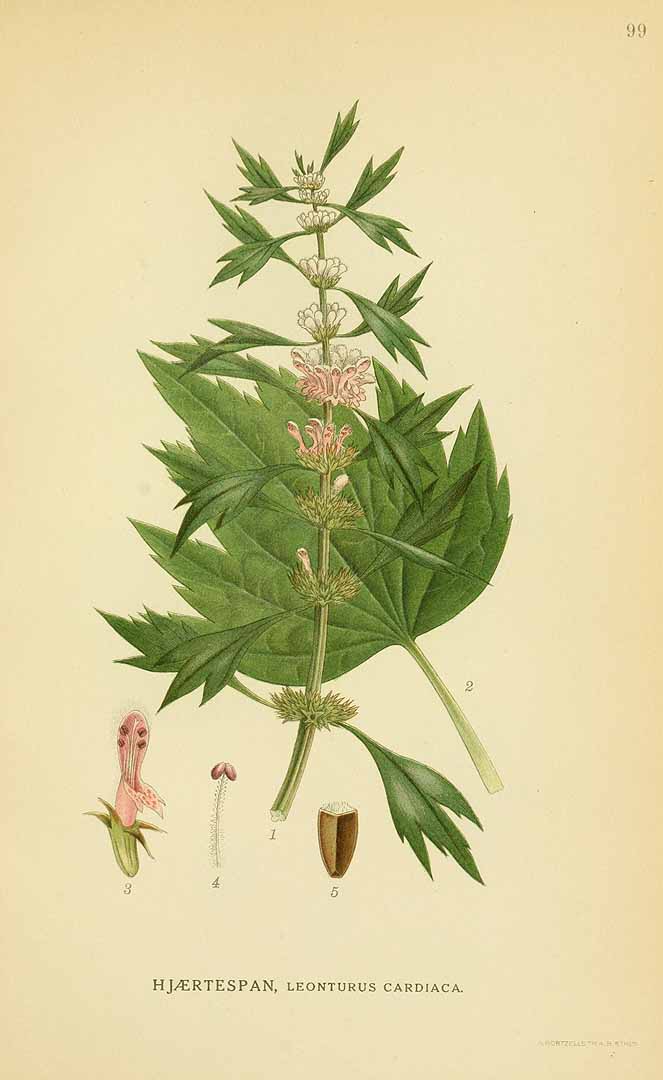
MATERIA MEDICA
Latin Name: Leonurus cardiaca
Common Name(s): Motherwort
Geographic Distribution: Grows throughout the temperate regions of the world in sunny areas
Primary Uses:
- May quite anxiety and nervous heart palpitations
- Has an affinity for the female reproductive areas, helps with menopause and PMS by gently stimulating the liver to move excess hormones through
- Specific for cramping associated with delayed menses,
- Amenorrhea (lack of a period) with bearing down lumbar pain
- Will bring on the menses if feeling delayed or repressed
- Can restore the menses when it is repressed due to higher regulatory centers
- Good to bring on the menses when it won’t return after going off BC
- Good for helping with uterine drainage, will tone the uterine muscles
- Strengthens without straining the heart, is lionhearted, a warrior plant, it gives strength to the emotional heart
- Good for insomnia related to stress and anxiety
- Good for women who are feeling particularly sensitive emotionally
Preparation & Dosing:
- Tincture – Fresh Plant 1:2, Recently Dry Plant, 1:5, 60% alcohol; 30-60 drops
- Tea – standard infusion (not a good tasting tea, best as a tincture)
Energetics:
Motherwort is bitter and slightly cooling, qualities that help bring balance to states of heat, intensity, and excess.
She is particularly suited for patterns of:
- overstimulation
- emotional intensity
- nervous system tension
- internal “heat” that shows up as irritability, anxiety, or restlessness
Because of this, many people prefer working with her as a tincture, though she can also be prepared as a tea.
The bitterness itself is part of the medicine, supporting digestion and helping to bring the body back into a more grounded, regulated state.
Parts Affected: Heart, uterus, nervous system
Actions:
- relaxant
- cardiac relaxant
- anti-spasmodic
- emmenagogue
- stimulates the uterus
- relaxes the heart
- nervine
Biochemical Constituents: Alkaloids, flavonoids, tannins, caffeic acid
Cautions:
- May disrupt the menstrual cycle in high doses
- Do not take while pregnant
- Do not take if menses is heavy

In many ways, Motherwort seems to find the people who need her.
Those whose hearts race ahead of them.
Those who hold more than they realize in their chest.
Those who feel deeply, love deeply, and sometimes become overwhelmed by the intensity of it all.
She is a plant for the tender-hearted, but also for the strong-hearted.
For those learning that the two are not separate.
To work with Motherwort is not to silence what you feel, but to be supported in feeling it.
To allow the heart to move without becoming overwhelmed. To soften without losing strength.
She doesn’t take anything away; she helps you stay.
If you’re feeling called to work with Motherwort, you can explore our small-batch preparations or join us in an upcoming class to deepen your relationship with this plant and others like her.
Resources:
- Bennett, R.R (2014). The gift of healing herbs. Berkeley, CA: North Atlantic Books.
- Corbett, Sarah. (2021). Motherwort Monograph. Rowan + Sage Herbaria Membership. Retrieved from https://community.rowanandsage.com/c/materiamedica/motherwort
- Edwards, G.F. (2000). Opening our wild hearts to the healing herbs. Woodstock, NY: Ash Tree Publishing.
- Eich, K. (2009). Motherwort: Healing the Anxious Heart and Mind. Retrieved September 2014 from http://www.redrootmountain.com/motherwort-healing-the-anxious-heart-and-mind/53
- Foster, S. (1993). Herbal renaissance. Layton, UT: Peregrine Smith Books.
- Hardin, K. R. (2013). 10 Reasons to Love Motherwort. Retrieved September 2014 from http://bearmedicineherbals.com/10-reasons-to-love-motherwort.html
- Hoffmann, David (2003). Medical herbalism. Rochester, VT: Healing Arts Press.
- McIntyre, A. (1996). Flower power. New York, NY: Henry Holt and Company, Inc.
- Popham, Sajah. Materia Medica Monthly, Volume #12: Motherwort (Leonurus cardiaca). Evolutionary Herbalism, 2024. Web. Accessed 8 May 2026.
https://school.evolutionaryherbalism.com/topics/motherwort-leonurus-cardiaca-part-1-2/ - Shikov, A. N., Pozharitskaya, O. N., Makarov, V. G., Demchenko, D. V. and Shikh, E. V. (2011). Effect of Leonurus cardiaca oil extract in patients with arterial hypertension accompanied by anxiety and sleep disorders. Phytotherapy Research, 25: 540–543. doi:10.1002/ptr.3292
- Herbarium Monograph: https://herbarium.theherbalacademy.com/monograph/motherwort/
Browse by category
- Aphrodisiacs
- Aromatherapy
- Astrology & Magic
- Ayurdeva
- Botany Foraging & Gardening
- Chakras
- Digestion
- Earth Connection
- Energetics
- Flower & Gem Essences
- Folk Traditions
- Herbalism & Holistic Health
- Immune Support
- Materia Medica
- Mushrooms
- Nutrition
- Seasonal Living: Autumn
- Seasonal Living: Moon Cycle
- Seasonal Living: Spring
- Seasonal Living: Summer
- Seasonal Living: Winter
- Skin & Body Care
Don’t Miss a Thing!
Enter your email below to be the first to know about sales, new products and tips for taking care of your pieces.